Sunday, June 16, 2013

heading north

We had the good fortune to be guests at a traditional Rwandan wedding.
On the street outside the host home it was a mix of guests and townspeople.
Most exciting for all.
The fashions were elegant


I made friends with this group of young ones as we waited.
 
There are three parts to a Rwandan wedding; this day takes 4 hours.
It is acted out as a play with family members taking the parts to reenact
the course of events beginning with the fathers agreeing to the marriage, traditional dances, the cows owner and shepherd singing, playing flutes and dancing, right though the bartering for how many cows the grooms family shall give the bride. It was a marvelous play full of laughter and love. We were served Fanta soda as we all sat for the 3.5 hours. Then there was a feast of rices, potato dishes, roasted bananas with beans, meats in delicious sauces and more.
 
The beautiful bride and groom.
 Katie and I left Kigal's heat and bustle and headed
north to Munsanze, Ruhengeri specific.
The taxi drive took about two hours and wound up through
the rugged terrain of central Rwanda. The land is
full of crops and farming, goats, cooler air and less congestion.
 A common way to transport anything and everything.
This is dried wood that will be used for cooking sources.
 
This fellow is holding on to
the back of the truck to hitch a ride up the hill.
 
Further north 
 
Croplands are tiered to avoid erosion. At the base you can
see brown crop squares. There are water channels that divide the squares
that are beneficial for watering the crops.
Along the way I saw a farmer standing in a trench bucketing water
onto one such plot. 
 
Fishing
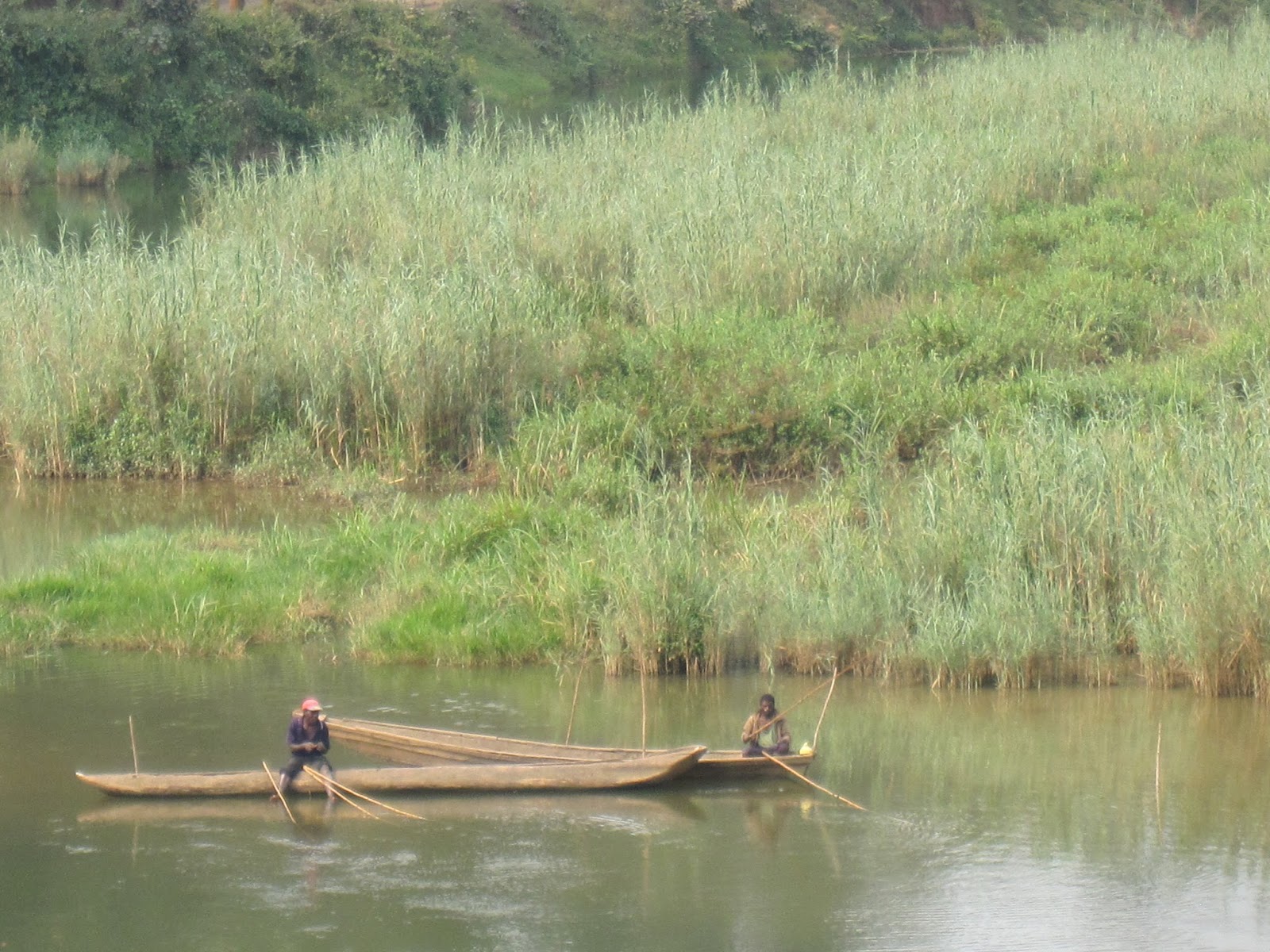
We got settled at Katie's home, complete with a sheep who grazes the yard outside our door, a beautiful yellow lab, a hen and many food gardens.
We then walked the 20 minutes to market to get
fresh produce and necessities. With a very dark sky looming
and two most heavy shopping sacks we opted to catch rides with two motos back to the house(motocycle taxis, see them in the 1st photo above).
Great fun and the most efficient way to get around.
There is a driver and you take the place behind,
strap on the helmut (the law) and off you go. 5 minute ride, 300 francs or $0.45.
Life is good! The dyeing begins this week.


Thursday, June 13, 2013

waking up in Rwanda

My first days in Rwanda have been beyond words. It's a beautiful place full of color, heat, warmth from the people I have met yet also incredibly jarring. Katie and I are staying outside Kigali for a few days at one of her dear friend's farm. Our first morning we awoke to early singing as the women sift the chaff from a crop of dried beans.
The great aunt, who is blind, still does the work as well.
The crops that are drying, which are common to the area,
are sorghum (shown here), beans and soy beans.

Today we joined Katie's colleagues for a home visit to 
a client in the hills of Kigali. International Justice Mission is partnering
with the Rwanda legal system to intervene in child sexual assualt.
This was a view along the way.

This little one greeted me when we arrived at our visit.


There is a goodness here....it is joyful yet incredibly heartbreaking.
This journey has just begun.

Sunday, June 09, 2013

into Africa

I am winging off to Africa in the morning.
Rwanda specific.
We moved the flock to a fresh pasture this morning
and dear Crystal still takes the last position
but she sure does love the trek.
She and I travel along together
ever so slow but with focus on the reward.
Fresh grass.

I will be landing in Kigali and traveling west and north with Katie.
She has been living there for almost 2 years as a
volunteer with True Vineyard Ministries, a non-profit business employing 35 widows
identified as the most vulnerable women in their communities
I have sent in seeds for dye plants and carry a bag full of natural dyes, fabric, string, and thread.
Options to assist this group of 35 widows of the Rwandan genocide who
are finding their way to support themselves and their families
in the aftermath. It has been almost 20 years but the pain is ever-present.
They are working to forgive in a culture of silence.
 
I am packed, but still incredulous and awestruck as I head east/southeast across the
pond and a very large Sahara.


Wednesday, June 05, 2013

symplocos in stock ~ dried leaf mordant

 
Long Ridge Farm is pleased to be a retail partner
in this most exciting project.
The Plant Mordant Project offers natural dyers a unique opportunity to avoid mordants produced by industrial processes and make reliable colors 100% from plants. Powdered leaf from Symplocos trees can replace alum in conventional natural dye recipes and produce some exciting new colors. Natural dyers already chose plant dyes over synthetic dyes because they are aligned with their values, and the Plant Mordant Project offers an opportunity to extend the expression of these values by also using a plant-sourced mordant.
.
At its source, the Plant Mordant Project builds partnerships for sustainability with rainforest communities and indigenous textile artists in Indonesia. Through its sourcing and sales of Indonesia’s traditional plant-sourced dye mordant, the Bebali Foundation (www.bebali.org) alleviates rural poverty and empowers women, saves rainforests, and supports the traditional textile arts. The Bebali Foundation brings to this project a decade of experience in the fields of conservation, indigenous culture, and rural livelihoods, while its partnerships with the Royal Botanical Gardens at Kew and the Indonesian Forestry Department, and its funding from the Ford Foundation bring world class scientific rigor and accountability.
 
I did a number of tests to confirm satisfaction in using symplocos
as a mordantand these silk scarves performed
with perfection at just 30% symplocos on the weight of the fabric. 
The reds are dyed with madder and the yellows with weld.

 I did a wool test with two skeins of our CVM/Romeldale 100% wool.
Both skeins are dyed with cochineal at 3%.
The left skein is mordanted with symplocos at
100% on weight of fiber and cream of tartar at 1.5%,
the right skein at 50%, no cream of tartar..
Vibrancy shows in both skeins
with minimal difference of saturation.
Symplocos gives the natural dyer a start to finish
natural process. It is simple to use and I find
it gives the fiber a nicer handle than mordanting with the alums.
With yarns I put the symplocos powder in a nylon stocking, knot the top
and proceed with the process. None of the powder leaches into the yarn
and the take up is excellent.

To purchase
How to use
 

Monday, June 03, 2013

disclaimer

I don't like beginning with the word "I"...ever. This life is not about me. Usually. Humor me this one day.

I am not a tracker of followers or people who read my blog. Good grief...where is there time for that work? So for all I know you haven't missed my posts. I am sorry I haven't followed more closely my favorite bloggers...abject apologies to each of you.

Paralysis set in a year ago. Being one to pour my guts out is not my style.
Typically, I share the things that go on at the farm, my excursions, workshops, the sheep, farm and pups, sometimes even a personal milestone. At this time, for me to move forward and post meaningfully means dumping a bad memory.

I suffered the strangest and most heart-wrenching experience in that spring season. Something
I never wish to duplicate, ever again. I followed my instincts which blew up and apart as no one could imagine. I know this is fodder for "Tell me more" but suffice to say I won't, in kindness to myself and those affected. What I will say is I fell apart. My intuition and I had a falling out (briefly). I seconded guessed and imagined it was all my inner workings. The work has been incredibly slow and painful. And laughably, at 59 years old, this shouldn't still occur. Yet it does for us all.

On a walk this late spring, I stood and looked at this oak leaf in an icy puddle on my morning walk understanding it's place. Sinking, floating, frozen, yet looking to the bright sky of a new season, transforming. That is me. On dry land now.

Sunday, May 05, 2013

how sweet it is

This is Charlotte. Once a lamb, now 7 years old.
This is Memphis, Charlotte's dam. Memphis won me a quite a few
fleece ribbons and Memphis' dam, Athena, took Grand Champion fleece 
at Black Sheep Gathering in Eugene, OR.
Just this spring this photo of Memphis was a winner
in a photo contest for a breed specific CVM/Romeldale.
I got an email this morning 
that Charlotte's fleece took 1st place in the 
breed specific CVM/Romeldale division
at the Maryland show. It's the largest show in the east.
I can't be more proud. Something as simple as this 
makes me higher than a kite.

Monday, March 11, 2013

a lady's man

Neville, a most handsome CVM/Romeldale ram, lived across the river on Betsy's farm. He vacationed on our farm and spent time with our pretty ladies.
A romancer caught in early morning.
He chose his women one by one and gave them a whole
day, complete with breakfast the day after.
and quiet time alone.
Pretty sweet offspring were created.
Sadly this love bear's time had come.
I was thankful to be there with Betsy when he died.
It was big and sad.
He left behind a good crop of lambs on both sides of the river.
He'll be missed.